



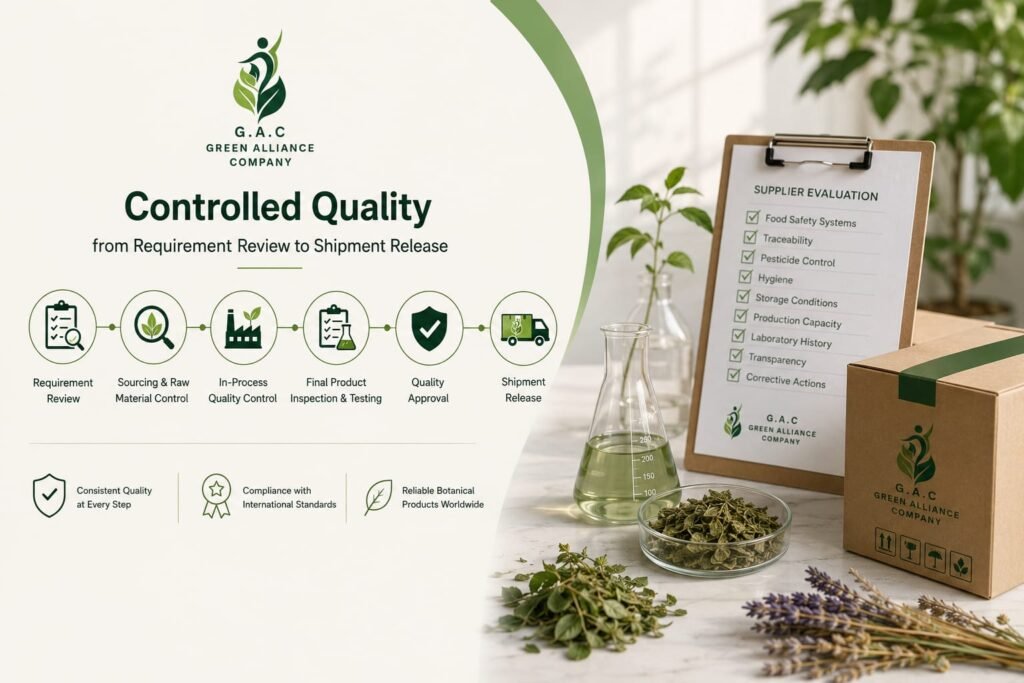


Green Alliance manages each customer project through documented procedures covering requirement review, supplier approval, contracted processing, laboratory verification, traceability, and final shipment release.
Every project begins with a detailed and documented review of the product identity, intended use, destination market, analytical limits, packaging requirements, treatment status, required certifications, and delivery conditions. This ensures that all customer requirements are clearly understood, technically assessed, and incorporated into the supply programme before execution begins.
Green Alliance applies a structured supplier-qualification process to ensure that every grower, supplier, processor, and service provider meets the technical, operational, and food-safety requirements of each project.
Our evaluation covers food-safety systems, traceability, pesticide-control practices, hygiene, storage conditions, production capacity, laboratory history, transparency, and corrective-action performance.
Through the Green Alliance Verified Supplier Programme, we maintain an internal system for supplier approval, monitoring, and continuous reassessment. This programme is an internal supplier-control process and is not presented as an independent certification.
Contracted processors are selected and monitored through documented controls designed to support consistent execution, full traceability, and compliance with customer requirements.
Our control process includes certificate and scope review, preliminary approval, facility audits, technical feasibility assessment, controlled work orders, production follow-up, record verification, CAPA monitoring, and periodic reassessment.
This approach allows Green Alliance to coordinate specialised processing capabilities while maintaining one accountable and controlled supply-chain system for the customer.
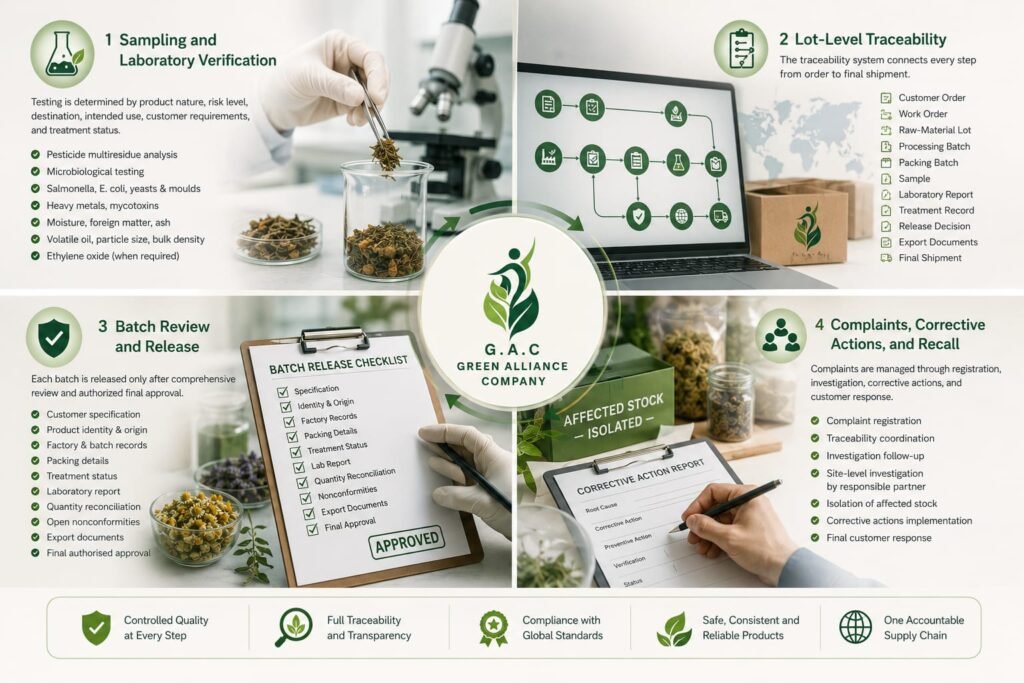
Testing requirements are determined according to the nature of the product, associated risk level, destination market, intended use, customer specifications, and treatment status. Tests may include pesticide multiresidue analysis, microbiological testing, Salmonella, E. coli, yeasts and moulds, heavy metals, mycotoxins, moisture, foreign matter, ash, volatile oil, particle size, bulk density, and ethylene oxide where required.
The traceability system connects the customer order, work order, raw-material lot, processing batch, packing batch, sample, laboratory report, treatment record, release decision, export documents, and final shipment.
A consolidated shipment file is maintained, while each industrial partner keeps the original production and batch records generated at its facility.
Completion of manufacturing or packing does not automatically mean that the product is ready for shipment. Each batch is released only after reviewing the customer specification, product identity, origin, factory records, packing details, treatment status, laboratory report, quantity reconciliation, open nonconformities, export documents, and final authorised approval.
Complaints are managed through formal registration, traceability coordination, investigation follow-up, and preparation of the final customer response. The responsible partner conducts the site-level investigation, isolates affected stock where necessary, and implements the appropriate corrective actions.
No account yet?
Create an AccountWhatsApp us